The Rise of Vertical AI
Competitive advantage in AI is shifting from big foundational models to specialized solutions using proprietary data to solve specific problems.
Total potential economic value creation
US$5.07 trillion
What does this trend encompass?
A fundamental shift is reshaping the AI ecosystem: as foundational models expand in scale and accessibility, their competitive advantage is migrating from model size to context, data, and application. Hyperscalers, such as Amazon, Google, Meta, and Microsoft, continue to invest billions into foundational models, racing toward artificial general intelligence, yet differentiation is increasingly being driven by specialized, vertical AI solutions integrated into industry workflows to solve domain-specific problems across sectors and value chains. Building on 2025's focus on broad AI accessibility, this trend creates unprecedented opportunities for sector-focused innovators, particularly in highly regulated industries such as healthcare, finance, and oil and gas, to capture value that even the most sophisticated foundational models cannot address.
Why is it important?
One-size-fits-all generic AI is being outcompeted by smaller, more resource efficient vertical AI solutions built on proprietary data. These smaller models can make AI applications more productive and accessible, while their localized deployment helps to address growing AI sovereignty and compliance requirements.
Enabling conditions and countries’ readiness
According to DET survey respondents, the widespread adoption of vertical AI solutions depends on:

Digital innovation: the advancement of vertical AI requires structures that enable collaboration between industry, researchers, and AI solution providers, supported by innovation environments such as testbeds, regulatory sandboxes, or AI–industry clusters.

Industry digital transformation: businesses need to adapt workflows and processes to integrate vertical AI solutions effectively from its development, by unifying fragmented data sources, to its implementation, by establishing clear data governance practices and creating industry platforms to facilitate peer-exchanges.

Digital infrastructure: the processing of proprietary domain data requires high-speed, low-latency connectivity and advanced computing infrastructure supported by robust security, data sharing, and data protection frameworks.
Economic, social, and environmental impact
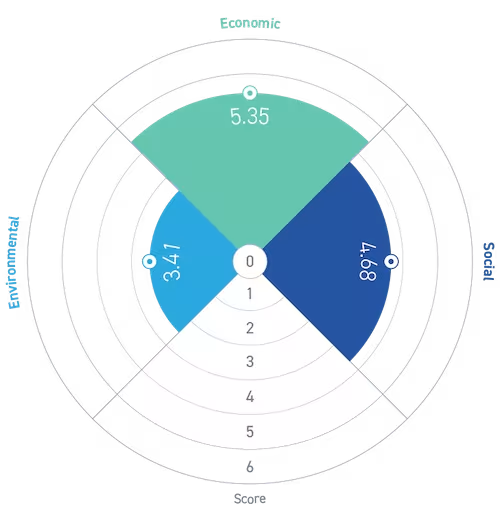
This trend ranks second in economic impact (5.35) but lower in social (4.68) and environmental (3.41) dimensions, reflecting risks such as job displacement, algorithmic bias, and increased energy and water usage. The highest economic impact is expected in Indo-Pacific and Asia and North America, with comparatively higher social and environmental impacts in the Middle East and Africa and Latin America.
Recommendations
Private sector
Introduce vertical AI solutions in a modular approach
to reduce deployment friction and cost and allow for easier verification of automated actions helping to foster trust and transparency.
Co-lead certified affiliated data collaboration zones
with industry peers, suppliers, and cloud partners to pool the proprietary domain data that fuels competitive vertical AI models, establishing shared governance for access rules, consent records, and audit trails.
Run cross-border pilots
demonstrating how vertical AI improves sector-specific outcomes like onboarding speed, fraud detection, and supply chain traceability through specialized models trained on industry data.
Embed efficiency-by-design
into vertical AI development through data minimization and energy-smart architectures that make specialized models sustainable and scalable.
Public sector
Launch national trust compacts on vertical AI
with industry and civil society to establish sector-specific rules for safe data sharing that enable specialized AI models while protecting competition and accountability.
Provide open testbeds and model contracts
tailored to high-value sectors, using procurement and grants to prioritize vertical AI solutions that demonstrate inclusion, energy efficiency, and cross-border interoperability.
Enable mutual recognition of vertical AI certifications
across borders to reduce compliance burdens and allow specialized AI models to scale efficiently across international markets.
IGOs, IOs, and others
Fund cross-sector demonstrations
proving how vertical AI delivers superior outcomes in healthcare, agriculture, finance, and other domains, with open results on inclusion and sustainability metrics.
Coordinate global policy alignment and knowledge exchange
to broker mutual recognition of sector-specific AI standards across regional frameworks to enable specialized models to operate seamlessly across different regulatory environments.
Build capacity for SMEs and underserved regions
through training programs and toolkits focused on developing, deploying, and maintaining vertical AI solutions in local contexts.
Foster inclusive AI ecosystems
by engaging SMEs, civil society, and all major groups across sectors in dialogues that inform the development of AI policies, ensuring they remain agile enough to account for the specificities of vertical AI and help spread the benefits of AI implementation across all communities.
Read the Digital Economy Trends 2026 report
Explore the full insights and analysis of the 2026 research.