Safeguarding Digital Wellbeing
Concern is growing that unhealthy digital habits are challenging mental health and social cohesion in ways that require new policy solutions.
Total potential economic value creation
US$2.63 trillion
What does this trend encompass?
The ubiquitous use of digital technologies and the rise of constant connectivity are transforming cultures and societies, reshaping how individuals interact, communicate, and access information. Concern is growing about unhealthy digital habits, mental health issues, and anti-social behavior, particularly among youth. AI systems are accelerating the spread of misinformation, undermining social cohesion. Governments and organizations are adopting stronger policies on digital wellbeing, fact-checking, and digital media literacy and integrating mental health and digital-ethics considerations into AI strategies and work practices. There is a pressing need for digital technologies and practices that actively support wellbeing and healthy, balanced, and responsible use of technology.
Why is it important?
Protecting mental wellbeing and combatting misinformation — especially among vulnerable users such as children — is vital to preserving trust, social cohesion, and informed public discourse in the digital age. Safeguarding digital wellbeing is also integral to building a sustainable digital economy, requiring trustworthy AI systems, widespread media literacy, and effective governance frameworks for emotional data and AI-generated content.
Enabling conditions and countries’ readiness
As identified by DET survey respondents, Safeguarding Digital Wellbeing rests on advances in:

Digital for Health and Education: age-appropriate design standards, digital services, the inclusion of digital media literacy in school curricula, and the expansion of mental health services can drive wellbeing and sustain trust in digital environments.

Digital for Sustainability: sustainability-first digital ecosystems that minimize energy use and materials consumption by prioritizing sufficiency over engagement maximization, thereby reducing attention pressure and stress and improving digital wellbeing.

Digital for Social Inclusion: to safeguard digital wellbeing, provenance labels, community oversight, and multilingual interfaces can prevent exclusion or targeted manipulation.
Economic, social, and environmental impact
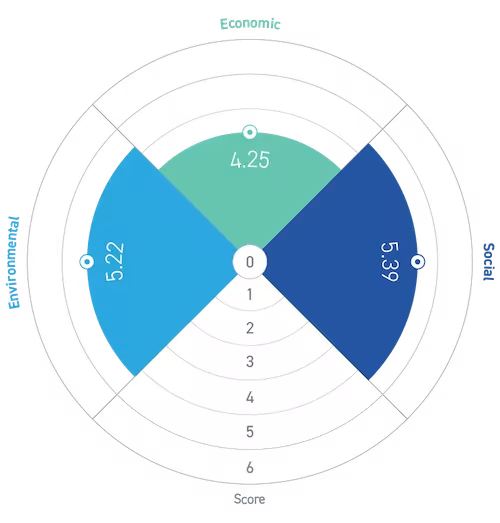
This trend has a relatively low positive economic impact (4.25) but ranks in the top two for social (5.39) and environmental (5.22) impacts. A safer digital world does not necessarily translate into greater profits, but improves societal cohesion and reduces negative externalities
Recommendations
Private sector
Establish cross-industry alliances to co-develop baseline standards for wellbeing-by-design
including age-appropriate controls, attention safeguards, and content provenance labels (such as C2PA) that restore trust in digital content.
Embed ‘health-by-design’ incentives and metrics into the architecture of digital platforms
such as social media apps and online marketplaces, as a core business risk management strategy prioritizing user wellbeing and engagement.
Collaborate with schools and health providers to offer digital media literacy resources and mental health support
positioning responsible design as a market differentiator that drives sustained user loyalty.
Public sector
Co-create unified, accountable, and open digital safety standards
through multilateral cooperation for algorithmic transparency, provenance labeling, and age-appropriate design.
Create sustainable funding mechanisms for digital wellbeing
that support media literacy, outcome-based auditing, and regulatory sandboxes, ensuring safer, more inclusive, and trustworthy online environments.
Invest in multilingual curricula
deployed through schools, libraries, and community centers to ensure that digital wellbeing protections reach all users, with country readiness scorecards tracking progress.
IGOs, IOs, and others
Convene international public-private coalitions to establish universal principles for digital wellbeing,
digital content integrity and authenticity, and equitable access.
Publish evidence-based policy guidance and actionable research on the mental health impacts
of immersive technologies, personal assistants, and AI-generated content.
Fund capacity-building initiatives in emerging markets
integrating media literacy with community oversight to ensure vulnerable populations receive sufficient support.
Launch a coordinated global program to combat online misinformation
raising public awareness, promoting fact-checking, and amplifying trustworthy sources across digital channels.
Read the Digital Economy Trends 2026 report
Explore the full insights and analysis of the 2026 research.