Powering a Sustainable Digital Economy
AI and data centers’ demand for electricity is constraining their potential to scale, making clean energy and efficiency strategic priorities.
Total potential economic value creation
US$2.86 trillion
What does this trend encompass?
Energy is becoming a major constraint on scaling digital technologies. The energy demand of data centers and AI infrastructure is growing faster than clean energy integration in many regions. It has become a strategic priority to invest in integrating renewable energy, while advancing efficiency innovations such as low-power chips, cooling systems, and AI-optimized energy use. With energy demand continuing to rise, this trend continues to play a critical role for the global digital economy.
Why is it important?
Without continued investment in energy generation capacity, and notably in low-carbon solutions and grid upgrades, the growth of the digital economy will be constrained. High and volatile energy prices could cause market power to concentrate, as it raises entry barriers and operating costs that disproportionately affect new and smaller market entrants. This could threaten market competitiveness, digital sovereignty, inclusion, and environmental sustainability.
Enabling conditions and countries’ readiness
According to DET survey respondents, the growth of Ambient Intelligence depends on:

Digital innovation: research and development (R&D) funding aimed at improving the energy efficiency of AI models, together with a policy environment that supports startups and incentivizes the roll-out and adoption of energy-efficient solutions, is essential to address the core challenge underpinning a sustainable digital economy.

Digital infrastructure: upgrading to modern power grid infrastructure such as smart grids, which combine advanced analytics, communication networks, and energy storage systems, would reduce energy losses in transmission and distribution, enable more efficient operations, and help to minimize environmental impacts.

Digital for Sustainability: digital technologies can support sustainability — for example, through grid efficiency — with key priorities including energy efficiency, waste reduction, and investment in sustainable energy generation, including renewable energy.
Economic, social, and environmental impact
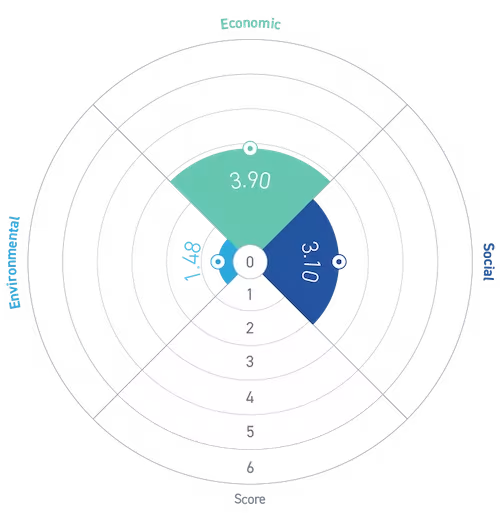
This trend ranks lowest across all three dimensions of economic (3.90), social (3.10), and environmental (1.48) impacts, reflecting ongoing challenges in meeting the growing demand for digital technologies while avoiding increases in emissions and the use of natural resources associated with rising energy consumption. Indo-Pacific and Asia (4.3) and the Middle East and Africa (4.2) rank highest for economic impact, and Latin America for social (3.4) and environmental impact (2.1).
Recommendations
Private sector
Set an energy-first growth plan for 2026 onwards that prioritizes efficiency and clean power,
committing to saving energy in every product and data operation while partnering with energy providers and local governments to lock in dependable renewables and pilot safe next-generation options.
Team up with peers to co-fund grid upgrades and green digital infrastructure,
sharing standardized simple, comparable energy metrics per AI task to drive collective efficiency, improve sustainability, and reduce operational risk.
Invest in innovative solutions to reuse data-center waste heat as a municipal energy input,
thereby reducing energy costs and company emissions.
Publicly track and report
simple energy, water consumption and emissions metrics, treating energy and water availability as a strategic imperative to de-risk future growth and ensure scalable AI deployment.
Public sector
Create pre-approved "clean compute zones" by 2026,
where clean energy projects and data centers are fast-tracked with guaranteed grid connections, clear rules, and simple reporting requirements for round-the-clock clean power use and heat reuse.
Co-fund grid improvements and energy storage with the private sector,
mobilizing blended public-private funds for transmission infrastructure to make regions investment-ready.
Foster public-private partnerships to modernize national energy grids,
ensuring they can support next-generation computing demands while advancing climate goals and equitable digital access.
Promote cross-sector initiatives that foster interdisciplinary innovation
and scale up climate finance to accelerate the development and adoption of more energy efficient digital technologies.
IGOs, IOs, and others
Publish practical energy-wise toolkits
covering heat reuse, better recycling, and circular economy principles for hardware, while running technical training programs to build local capacity.
Introduce a simple, trustworthy "clean compute" label
to guide global buyers and unlock finance, making it easier for organizations to support sustainable digital infrastructure.
Promote the adoption of shared global standards and best practices for energy-efficient AI
to foster a more inclusive digital economy, enhance global resilience, and support equitable participation.
Read the Digital Economy Trends 2026 report
Explore the full insights and analysis of the 2026 research.