The Dawn of Ambient Intelligence
Sensors in everyday environments are forming an invisible layer of intelligence, using edge computing to optimize decisions and experiences.
Total potential economic value creation
US$4.21 trillion
What does this trend encompass?
Sensors are increasingly being integrated into everyday objects and environments to provide a layer of ambient intelligence, driven by their decreasing cost. The sensors are often combined with edge computing — in which data are processed closer to their source — as centralized systems cannot efficiently handle the data volumes and latency requirements. Smart systems are seamlessly embedded into the physical and digital spaces around us, forming an invisible layer of ambient intelligence that operates in the background to enhance services, optimize decision-making, and enrich user experiences.
Why is it important?
Ambient intelligence continually interprets real-time data and takes adaptive actions, powering autonomous systems and optimizing processes in multiple domains in ways that can offer societal and economic benefits. However, its pervasive data collection and automated decision-making raise complex questions about privacy, accountability, and whether those benefits are distributed equitably
Enabling conditions and countries’ readiness
According to DET survey respondents, the growth of Ambient Intelligence depends on:

Digital innovation: startup incubators dedicated to ambient intelligence in specific sectors with a strong focus on fostering and enabling collaboration and bringing relevant actors together.

Digital infrastructure: seamless, reliable, and high-speed connectivity is the foundation for ambient intelligence, alongside edge computing infrastructure.

Industry Digital Transformation: industries need to adapt workflows and systems, develop and deploy shared standards, and embed AI and sensors in their physical environment to reap the benefits of ambient intelligence.
Economic, social, and environmental impact
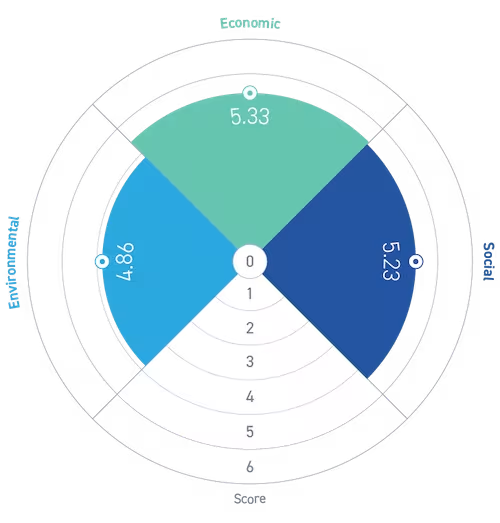
This trend performs strongly across economic (5.33), social (5.23), and environmental (4.86) domains, reflecting benefits from improved accessibility to energy efficiency and material and environmental savings. Latin America (5.84) and Indo-Pacific and Asia (5.69) rank the highest for economic impact, while Indo-Pacific and Asia and North America is the leader for social and environmental impact.
Recommendations
Private sector
Establish a cross-industry alliance on trusted ambient ecosystems
to co-develop and fund open interoperability standards for low-cost sensors and edge computing, shifting from proprietary silos to infrastructure that enables collaboration
Prioritize privacy-by-design frameworks that embed transparency into ambient services
from inception, earning consumer confidence and grounding competition in responsible innovation.
Invest in workforce upskilling to enable teams to interpret real-time data insights
and translate them into operational value across manufacturing, energy, and healthcare domains.
Co-develop trusted deployments with governments and academia
through cross-sector compacts that combine interoperable sensors with edge analytics and use third-party audits to verify user consent.
Public sector
Launch sandboxes for innovation in ambient intelligent systems,
enabling entrepreneurs and civil society to co-design and future-proof governance that balances rapid innovation with robust privacy, security, and equity safeguards for vulnerable populations.
Establish national data trusts for high-value public datasets
and create regulatory green lanes for certified ambient solutions built on open standards, providing clear rules and safe harbors for innovators.
Partner with the private sector to pilot ambient systems in public services
like healthcare, transportation, and emergency response, demonstrating responsible deployment at scale and building citizen trust.
Use procurement to reward privacy-by-design, interoperability, and local data minimization
while aligning incentives for SMEs to adopt standards and skills that promote universal and affordable access to ambient intelligence technologies.
IGOs, IOs, and others
Develop open-source playbooks for the ethical deployment
of smart systems, focusing on interoperability, data sovereignty, and human rights protection.
Create a global ambient intelligence public stack
with open-source software, reference architectures, and auditable algorithms that lower barriers for entrepreneurs in emerging markets.
Direct capacity-building programs and funding for emerging economies,
ensuring equitable, and affordable access to ambient intelligence and working to prevent digital divides.
Advocate for inclusive design principles in ambient intelligence
that prioritize accessibility and protect marginalized communities from surveillance harms through shared best practices and equity impact studies.
Read the Digital Economy Trends 2026 report
Explore the full insights and analysis of the 2026 research.