Emergence of Competing Technology Blocs
Countries and corporations are coalescing into blocs which share standards, improving interoperability within but not between blocs.
Total potential economic value creation
US$2.92 trillion
What does this trend encompass?
As countries strengthen their digital economies through industrial policies, a broader global pattern is emerging: groups of countries and corporations are increasingly aligning around technology standards, frameworks, and regulations. Interoperability is increasing within these emerging blocs, but often reducing between them. Driven by the need for more resilient supply chains, secure digital infrastructure, and access to increasingly complex and capital-intensive technologies, the shift from national efforts toward more regional and multi-country collaboration is influencing semiconductor production, cloud and data ecosystems, AI governance approaches, and digital trade frameworks. These dynamics are reshaping the global digital economy into a set of interconnected but increasingly differentiated technology spheres.
Why is it important?
The emerging blocs create new pathways for shared standards, pooled investment, and more resilient supply chains. However, they make it harder for firms — especially in emerging economies — to operate seamlessly across markets with increasingly different compliance rules, technical standards, and regulatory expectations. How countries navigate these ecosystems will determine whether they gain access to broader innovation networks or face higher costs and barriers to entry.
Enabling conditions and countries’ readiness
According to DET survey respondents, the growth of Strengthening of End-to-End Cybersecurity depends on:

Industry Digital Transformation: countries with digitally mature industries — using aligned standards, interoperable systems, and integrated supply-chain technologies — are better positioned to participate in cross-country manufacturing, cloud, and AI ecosystems. Higher industrial interoperability lowers coordination costs and accelerates the formation of technology blocs.

Digital Capabilities: strong domestic talent pipelines in areas such as AI engineering, semiconductor fabrication, cybersecurity, and cloud operations increase a country’s ability to integrate with regional technology ecosystems. When countries’ skill bases are sufficiently advanced and compatible, cross-country collaboration, knowledge transfer, and ecosystem-building become more feasible.

Digital Innovation: a strong innovation ecosystem attracts cross-country investment and enables joint projects because shared research capacity, complementary expertise, and aligned technological standards reduce collaboration costs and create incentives for firms and governments to co-invest in new technologies.
Economic, social, and environmental impact
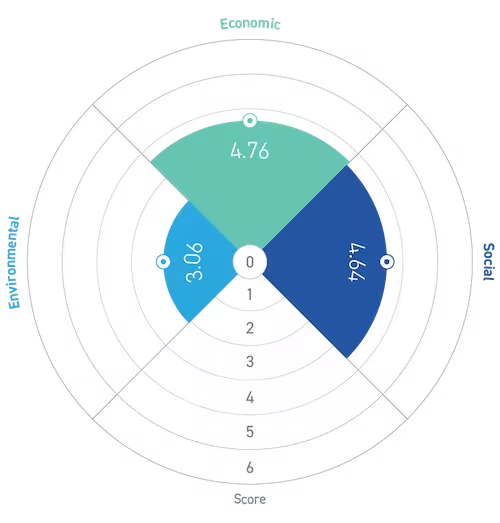
The positive economic (4.76), social (4.64), and environmental (3.06) impacts of this trend are all relatively modest, suggesting that while respondents see some economic and social benefits from regions strengthening their own technology ecosystems and supply-chain positions, they do not expect these shifts to yield broad gains. The environmental impact score is even lower, reflecting how activities driving technology blocs — such as semiconductor fabrication, data center expansion, and advanced manufacturing – tend to be energy-intensive and emission-heavy.
Private sector
Advance the adoption of flexible and modular technology architectures
that allow products and services to adapt to different regional standards in areas such as semiconductors, cloud infrastructure, and AI systems, reducing redesign costs while meeting bloc-specific compliance requirements.
Invest in regional talent ecosystems
by co-funding programs with governments and educational institutions to build specialized skills in AI, semiconductor design, cloud operations, and cybersecurity to strengthen competitiveness across blocs.
Engage with industry consortia and technical bodies to shape interoperable standards
in areas such as data exchange, AI governance, identity management, and cloud services to minimize compliance fragmentation and enable firms to scale across blocs.
Diversify supply chains across regions
in areas such as semiconductors, cloud, and hardware to reduce exposure to bloc-specific disruptions or export controls.
Public sector
Co-invest with neighboring countries and industry partners
to build shared semiconductor capacity, data center hubs, and regional AI infrastructure, supporting strategic autonomy across aligned markets while reducing cost duplication.
Establish mutual recognition frameworks across regulatory systems
that enable technology transfers, talent mobility, and interoperability for specific sectors, allowing firms to operate across blocs without excessive compliance hurdles.
Invest in digital skills development
through STEM education, technical vocational training, and continuous reskilling programs that build national talent pipelines for AI, cybersecurity, semiconductors, and cloud engineering.
Support SMEs through simplified compliance pathways
and shared digital services so they are not disproportionately disadvantaged by fragmented standards across blocs.
IGOs, IOs, and others
Facilitate inter-bloc dialogue to establish minimum interoperability standards
in semiconductors, cloud infrastructure, and AI systems to enable essential cross-bloc collaboration while respecting different regulatory environments.
Build capacity in emerging economies
through technology transfer, open-source platforms, shared toolkits, and regional training programs that help prevent widening divides.
Develop global frameworks for monitoring the economic, social, and environmental implications
of fragmented technology systems, to help countries make informed decisions.
Promote sustainable models for regional cooperation
that reduce redundant infrastructure investments and improve transparency and accountability in implementing digital strategies.
Read the Digital Economy Trends 2026 report
Explore the full insights and analysis of the 2026 research.