Delivering Hyper-Personalization
AI systems that continuously learn from users are tailoring solutions to individuals in real time in areas such as healthcare and education.
Total potential economic value creation
US$2.97 trillion
What does this trend encompass?
AI systems are creating a new ‘learning loop’ in which human interaction continuously refines algorithms, improving their ability to deliver experiences tailored to individual preferences and real-time contexts. What began as hyper-personalized retail experiences in 2025 has expanded across sectors including healthcare, education, and finance, enabling individualized solutions that touch the core domains of human development and professional growth. This evolution marks a shift from personalization as a consumer convenience to personalization as a driver of empowerment, wellbeing, and productivity.
Why is it important?
By enabling continuous adaptation to user behavior, these AI-driven systems can empower individuals, improve outcomes, and strengthen user engagement — although long-term success depends on maintaining user trust. Organizations will need to embed ethics, privacy, and responsible use of frontier technologies at the core of their business strategy to sustain public confidence and avoid user alienation.
Enabling conditions and countries’ readiness
According to DET survey respondents, the growth of Ambient Intelligence depends on:

Digital for Work and Training: skills development in personal data identification, strategy, and governance are essential to uncover new use cases for digital personalization.

Digital for Social Inclusion: fair access, inclusive datasets, multilingual interfaces, accessibility features, low-data modes, and community oversight are needed to prevent algorithmic bias and exclusion in hyper-personalized products and services.

Digital Innovation: low-code and no-code platforms enable non-technical users to develop new personalized products and services. Moreover, fostering experimentation and rapid prototyping in this space can yield significant competitive gains.
Economic, social, and environmental impact
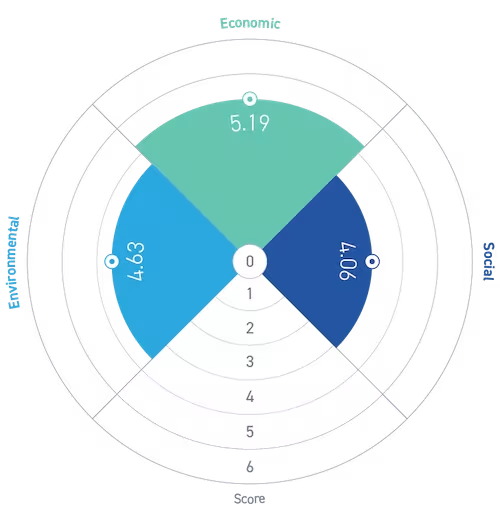
This trend ranks among the top five for positive economic (5.19) and environmental (4.63) impacts, but it has a weaker social (4.06) impact, as shown in Figure II.4. Its strong economic impact is derived from the revenue growth from hyper-personalization driven sales. Latin America (5.70) ranks the highest for economic impact
Recommendations
Private sector
Embed ‘trust-by-design’ principles
in service offerings and business processes as a central risk management strategy.
Proactively align privacy-preserving learning processes with emerging global regulatory standards
to mitigate compliance risks and associated costs.
Collectively fund independent third-party auditing agencies
to certify personalization systems for bias, privacy risks, and manipulative practices.
Strengthen workforce capabilities in data ethics, AI literacy, and digital skills
through continuous learning and partnerships with educational institutions, ensuring that hyper-personalized systems are designed and deployed responsibly and transparently across sectors.
Public sector
Launch regulatory sandboxes where companies can test hyper-personalization systems
under supervised conditions with clear ethical guardrails before scaling.
Establish secure, state-backed ‘personal data utilities’
where citizens can store personal data and grant granular, time-bound access to services via standardized APIs, to transform consent from a one-time-only checkbox into a dynamic, trust-enabling, co-creative process.
Co-create comprehensive certification standards
with industry and consumer groups as a part of broader policies for digital economy, mandating transparency in algorithmic decision-making, data usage, and personalized pricing practices to prevent pricing collusion and discriminatory outcomes.
IGOs, IOs, and others
Support ongoing convening efforts of governments, industry, international organizations, and civil society
to co-develop interoperable frameworks for consent, trustworthy AI systems, data portability, and bias mitigation that enable cross-border and cross-sectoral personalization while safeguarding individual digital rights.
Establish an independent algorithmic incident reporting center
modeled on transportation safety boards, to confidentially investigate, publish anonymized digital harms, and promote best practices on hyper-personalization.
Launch shared testbeds and benchmarks
evaluating on-device personalization, federated learning, and fairness across languages and contexts, accompanied by country scorecards tracking progress on the implementation of inclusive personalization practices.
Read the Digital Economy Trends 2026 report
Explore the full insights and analysis of the 2026 research.