Embracing Immersive Hybrid Experiences
Digital twins, VR, XR, and spatial computing are blurring physical-virtual boundaries, reshaping how we work and live.
Total potential economic value creation
US$4.14 trillion
What does this trend encompass?
The boundaries between physical and virtual worlds are increasingly blurred, as immersive hybrid experiences transform industries and reshape how we live and work. This trend represents a continuum of innovation: from digital twins, as virtual replicas of physical systems enabling real-time monitoring and simulation; to virtual reality (VR), providing immersive simulations of physical environments; and eventually to spatial computing, which seamlessly blends digital information with the physical world.
Why is it important?
Spatial computing, digital twins, and immersive reality can unlock operational efficiency and learning for complex operations and environments. Real-time monitoring and predictive simulations enable proactive failure prediction and system optimization at scale. However, the widespread adoption of these technologies depends on resolving barriers around privacy concerns, cost, usability, and data and operational governance.
Enabling conditions and countries’ readiness
According to DET Survey respondents, realizing the potential of Immersive Hybrid Experiences depends on:

Digital Infrastructure: high-speed, low-latency networks with edge compute and 5G and fiberoptic capabilities are central to effectively delivering seamless, real-time hybrid experiences.

Industry Digital Transformation: accelerating the industrial adoption of hybrid experiences requires redesigning workflows that place spatial interfaces and digital twins within core production and service processes.

Digital Innovation: innovation around interoperable 3D software, domain data, and provenance standards with modular tools will allow immersive hybrid experiences to function across vendors, devices, and environments.
Economic, social, and environmental impact
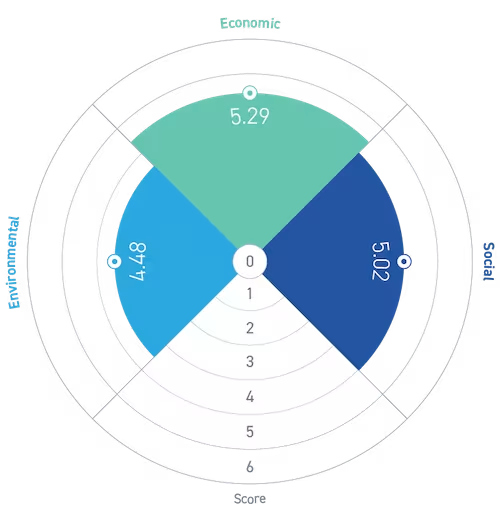
This trend has strong positive economic (5.29) and social (5.02) impact. Immersive hybrid experiences can enhance engagement, production techniques, and service delivery. High energy requirements help to explain its weaker environmental impact (4.48). The economic impact is highest in North America (5.98).
Recommendations
Private sector
Co-develop cross-sectoral alliances to prevent vendor lock-in
by establishing pre-competitive, open and interoperable standards for the foundational plumbing of digital twins, spatial computing, and extended reality (XR) systems.
Align on common and shared disclosure metrics of hybrid-experience use cases
to unlock investment by reporting on cost savings, safety improvements, and accessibility gains benchmarked against traditional performance indicators.
Accelerate innovation and manage risk by establishing industrial metaverse sandboxes
that create shared reference architectures for federated data-sharing to collaboratively train AI models on privacy-preserved data that does not provide access to proprietary information.
Invest in workforce upskilling programs
that build practical expertise in XR design, spatial data management, and digital twin operation, ensuring employees can effectively create, maintain, and optimize immersive hybrid environments.
Public sector
Champion interoperable policy frameworks
that designate virtual replicas of critical public systems — for example, energy grids, transportation networks, and healthcare facilities — as essential public goods.
Co-create open and auditable standards
for AI and data sovereignty, user consent, and meaningful algorithmic transparency for devices, platforms, and use cases that balance innovation with privacy, safety, and accessibility requirements.
Leverage public procurement to catalyze trustworthy solutions in priority sectors
such as healthcare, energy, urban transport, and natural disaster readiness.
Establish enforceable digital rights for individuals in hybrid environments
that explicitly address the risks of continuous biometric and behavioral data collection, especially in public and/or youth-focused contexts.
IGOs, IOs, and others
Advance the adoption of a shared set of global norms
for data ownership, user consent, and responsible AI governance in the merging of physical and virtual worlds.
Convene governments, industry, researchers, and civil society to co-design model policies and technical benchmarks
that can be adopted by states and communities to address privacy and surveillance risks from continuous biometric and behavioral data collection in virtual/physical worlds.
Fund training networks and technology transfer programs for emerging economies
focusing on healthcare, infrastructure, and climate resilience to ensure widespread capacity building and avoid deepening the digital divide.
Establish international standards and certification frameworks for immersive technologies
to ensure interoperability, user safety, ethical use, and equitable access across borders, fostering trust and enabling scalable, responsible adoption of hybrid physical–virtual experiences.
Read the Digital Economy Trends 2026 report
Explore the full insights and analysis of the 2026 research.