The Holistic Digital Trade Revolution
International trade is shifting towards digital services, requiring new agreements on cross-border data flows and regulatory frameworks.
Total potential economic value creation
US$3.63 trillion
What does this trend encompass?
Digital services are reshaping international trade, shifting value creation from physical goods to cross-border digital solutions. Technology advances are expanding the range of tasks that can be digitalized and traded, from financial services and education to creative industries and AI-powered solutions. This expansion depends on digital trade policy frameworks that enable data mobility, interoperable digital-payment systems, trusted digital identity, and secure cloud infrastructure. New international trade agreements will be essential to enable fair market access and responsible technology transfer amid the rise of digital sovereignty approaches. Clear, harmonized standards for cross-border data interoperability, security, data governance, and intellectual property (IP) will be crucial to build trust, security, and global economic integration.
Why is it important?
Digital trade is becoming a core driver of growth and participation in the global economy. Yet the necessary rules, infrastructure, and trust frameworks are evolving unevenly. If standards for data, security, and IP remain fragmented, restrictions and compliance costs will limit market access, particularly for emerging economies and smaller firms. Advancing interoperable, secure, and transparent digital trade systems is essential for expanding economic opportunity, enabling fair participation in global markets, and preventing widening divides in the digital economy.
Enabling conditions and countries’ readiness
According to DET survey respondents, the growth of Strengthening of End-to-End Cybersecurity depends on:

Industry Digital Transformation: business systems (e-invoicing, digital payments, and contracts) that align to common compliance standards and are auditable by design will reduce friction and increase execution speeds of cross-border digital services.

Digital Capabilities: workforce skills that support AI-enabled compliance, digital rights management, and secure data handling reduce trade errors and disputes while enabling digital services to be scaled into new markets.

Digital Infrastructure: interoperable data and payments rails, cross-border digital identity systems, and secure cloud environments support trusted data mobility and help services move reliably across jurisdictions.
Economic, social, and environmental impact
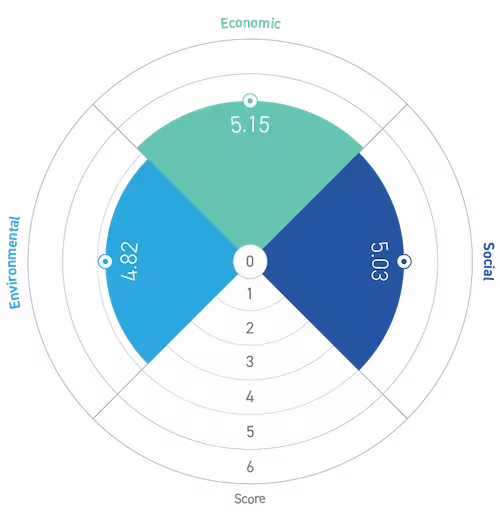
This trend ranks third-highest for its positive environmental impact (4.82), highlighting efficiency gains from paperless trade and reduced physical logistics, and in the upper-middle tier for economic (5.15) and social (5.03) impacts. North America ranks highest for environmental impact, while private sector respondents (5.24) foresee higher economic benefits than those from government (4.98). Overall, the outlook for the next 12-18 months is positive, with trend adoption expected to generate meaningful benefits across regions and impact areas
Recommendations
Private sector
Advance the adoption of interoperable digital trade infrastructure
by implementing cross-border payment rails, standardized e-invoicing systems, and verified digital identity frameworks that enable seamless transactions across multiple jurisdictions.
Invest in digital trade capabilities
by training teams to manage cross-border data flows, IP licensing, digital contracts, and multi-jurisdiction compliance using AI-powered tools that reduce errors and accelerate dispute resolution.
Accelerate the industry-wide adoption of transparent trust metrics
by publishing auditable certifications on payment reliability, data protection standards, and transaction integrity that demonstrate proven performance in secure cross-border digital commerce.
Public sector
Establish pro-innovation frameworks with security standards
by co-creating interoperable rules for cross-border data flows, digital identity verification, and payment systems that provide regulatory certainty while ensuring strong authentication and fraud prevention.
Modernize trade infrastructure
by digitizing customs, simplifying tax compliance for digital services, and streamlining consumer protections to make cross-border digital commerce accessible for local entrepreneurs and SMEs.
Develop digital trade capabilities
through targeted programs that empower entrepreneurs, SMEs, and workers with skills in cross-border compliance, digital contracts, IP management, and payment systems.
IGOs, IOs, and others
Harmonize digital trade infrastructure
by convening global coalitions to develop reference architectures for cross-border payment systems, digital identity frameworks, and data exchange protocols that balance interoperability with sovereignty concerns.
Deploy practical capacity-building programs
including open-source toolkits for digital identity integration, payment system compliance, e-invoicing implementation, and cross-border data governance that lower barriers for emerging economies to participate in digital trade.
Align trade policy with digital advances
by strengthening multilateral dialogues that establish shared standards for data interoperability, IP protection, and transaction security while preventing regulatory fragmentation that creates compliance barriers.
Read the Digital Economy Trends 2026 report
Explore the full insights and analysis of the 2026 research.